
Get Started

REAL CHEM students reach their course one of two ways. Identify which one applies to you:

  1. A single sign-on (SSO) in your school website, like Canvas, Blackboard, or Brightspace. A single sign-on link never asks you to sign in — it just takes you directly to the course. If your instructor uses a REAL CHEM SSO link, that’s all you need!
  2. An enrollment URL. When you follow an enrollment URL you’re asked to sign in to REAL CHEM’s platform Torus, or create an account if you don’t have one yet. This is called “Direct Delivery.”

Direct Delivery students

Enroll in OLI Torus course (one time)

Follow the invitation link, create an account, confirm the email address, sign in to OLI Torus, and access the course materials. See the detailed steps below the video.

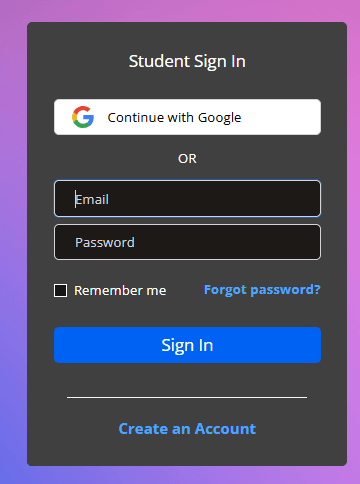
  1. Follow the invitation URL provided by your instructor / school and click Create an Account on the right side of the page or sign in with an existing account. Use a valid email.

    View the confirmation message: To continue, check your email for a confirmation email. If you don’t receive this email, check your Spam folder or verify that the entered email is correct. 
    The tab may be closed.
    Note: If you do not receive an email confirmation, please email oli-help@cmu.edu for assistance. Don’t forget to check SPAM or other filtered folders!

  2. Click the Confirm Email button from the email confirmation in that inbox with the subject “Confirm your email address” from Open Learning Initiative to confirm the email and go to the sign-in page.

  3. Sign in with your new account on the right side of the page. Note: Sign in even if the sign-in is labeled instructor sign-in.


  4. Click to check “I’m Not a Robot” and Enroll.
    blank

  5.  Click the start course message as indicated by the Welcome course landing page.
    blank


    Make a note of your OLI Torus Learner Account ID (email address) and Password!
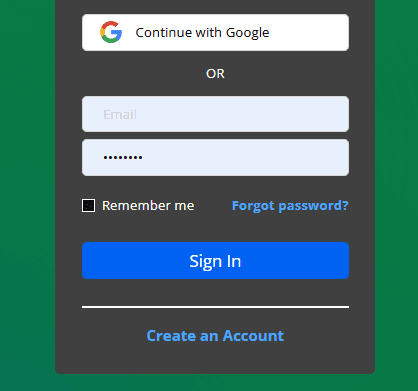
Access OLI Torus after enrollment in the course section

Return to your REAL CHEM course by signing in at at https://proton.oli.cmu.edu/ with the existing learner account. 
blank
 

Have Questions?

Contact Us
01

Chemical Kinetics

  • Reaction Rates
  • Rate Laws
  • Reaction Mechanisms
  • Exploration: Catalyst in the Clouds
02

Chemical Equilibrium

  • Concepts of Chemical Equilibrium 
  • Le Châtelier’s Principle 
  • Equilibrium Calculations
  • Exploration: Let’s Get the Lead Out!
03

Acids and Bases

  • Defining and Measuring Acids and Bases
  • Strong and Weak Acids and Bases
  • Exploration: Proton Power! pH and Protein Structure
04

Applications of Aqueous Equilibrium

  • Buffers 
  • Titrations
  • Solubility and Complex Ion Equilibria
05

Thermodynamics and Energy → What Drives a Reaction?

  • Introduction to Thermodynamics
  • The Second Law of Thermodynamics
  • Free Energy 
06

Electrochemistry

  • Foundational Concepts of Electrochemistry
  • Galvanic Cells 
  • Other Applications of Electrochemistry
07

Nuclear Chemistry

  • Nuclear Reactions and Equations
  • Applications of Nuclear Chemistry
08

Transition Metals and Coordination Chemistry

  • Occurrence, Preparation, and Properties of Transition Metals
  • Coordination Chemistry of Transition Metals
  • Spectroscopic and Magnetic Properties of Coordination Compounds
  • Exploration: Dazzling d-Orbitals
09

Appendix (REAL CHEM II)

  • Page: Specific Heats of Common Substances
  • Page: Solution for Large K
  • Page: Solution for Small K
  • Page: Ka Values of Common Weak Acids
  • Page: Kb Values of Common Weak Bases
  • Page: Solubility Products
  • Page: Titration
  • Page: Acid-Base Chemistry of Butterfly Tea and the Ocean
  • Page: Formation Constants for Complex Ions
  • Page: Standard Reduction Potentials
  • Page: Thermodynamic Properties
10

Appendix : PhET Simulations (REAL CHEM II)

  • Page: Gas Properties PhET Simulation
  • Page: Reactions and Rates PhET Simulation
  • Page: Acid-Base Solutions Introduction PhET Simulation
  • Page: pH Scale PhET Simulation
  • Page: Concentration PhET Simulation
  • Page: Salts and Solubility PhET Simulation
  • Page: Build a Nucleus PhET Simulation
  • Page: Radioactive Dating Game PhET Simulation
11

Glossary (REAL CHEM II)

  • Glossary (REAL CHEM II)
12

Instructor only resources (REAL CHEM II)

  • Page: In-class slide decks
  • Page: In-Class Active Learning Activities
  • Page: Learning objectives by module REAL CHEM II
Get Access
01

Unveiling the Power of Matter and Energy

  • Basic Concepts of Matter and Energy
  • Measurements
02

Unit 2: Atoms, Molecules and Ions

  • Atomic Theory and the Periodic Table
  • Compounds and Chemical Formulas
  • Exploration: Do you really want to drink that? The elements of water.
03

Electronic Structure and Periodic Properties

  • Electromagnetic Energy and the Bohr Model of the Atom
  • Quantum Theory
  • Periodic Properties
  • Exploration: What’s the World Made Of? Unlocking Secrets with Spectroscopy
04

Chemical Bonding and Molecular Geometry

  • Ionic and Covalent Bonding
  • Lewis Structures
  • Molecular Structure and Polarity
  • Advanced Theories of Covalent Bonding
  • Exploration: Decoding the Mystery of Greenhouse Molecules
05

Composition
of Substances

  • Mole Calculations
  • Aqueous Solutions
  • Exploration: Is the Town Toxic? Quantifying Concentrations of Lead.
06

Reactions and
Stoichiometry

  • Chemical Reactions and Equations
  • Chemical Reactions Stoichiometry
  • Exploration: Driving Down Greenhouse Emissions
07

Gases

  • Gas Laws
  • Stoichiometry of Gases
  • The Kinetic-Molecular Theory
08

Thermochemistry

  • Introduction to Energy
  • Calorimetry
  • Enthalpy
  • Exploration: What’s Our Next Big Energy Source?
09

Liquids and Solids

  • Intermolecular Forces
  • Phase Changes
  • The Solid State of Matter
10

Solutions

  • Solubility
  • Colligative Properties
Get Access